00 / Case study
Eleven sites, one agency,
one way of building.
A brand agency sends me a finished design and a date. I build the site, launch it and keep it running. Eleven of them in nineteen months, for property developments and the developers behind them. All under the agency's name: their team builds new pages and updates content in the control panel without a developer, and their clients have never heard of me.
-
11
Sites in the
partnership -
08
Built from
scratch -
03
Taken over from
another developer -
00
Add-ons to
keep updated
- Client
- A brand and communications agency
- Role
- White-label development partner
- Stack
- Statamic
- Since
- 2025, ongoing
01 / Starting point
The agency designs. It does not build. In early 2025 it gave me one site to find out how that would go, and promised nothing after it.
The only way to get the second one was to make the first easy to live with. Their editors had to run it without me, and another developer had to be able to take it over without a handover call.
Eleven sites later that is still the arrangement. They keep the client, I build and maintain, and my name is nowhere on it. Three of the eleven came from the developer they used before. Finished code, no documentation, and already live, so I had to get it right from the start.
02 / Constraints
- A different brand every time
- Each project is its own identity, so nothing visual carries from one to the next. Whatever gets reused has to sit underneath the design, where it cannot dictate how a page looks.
- Their people publish
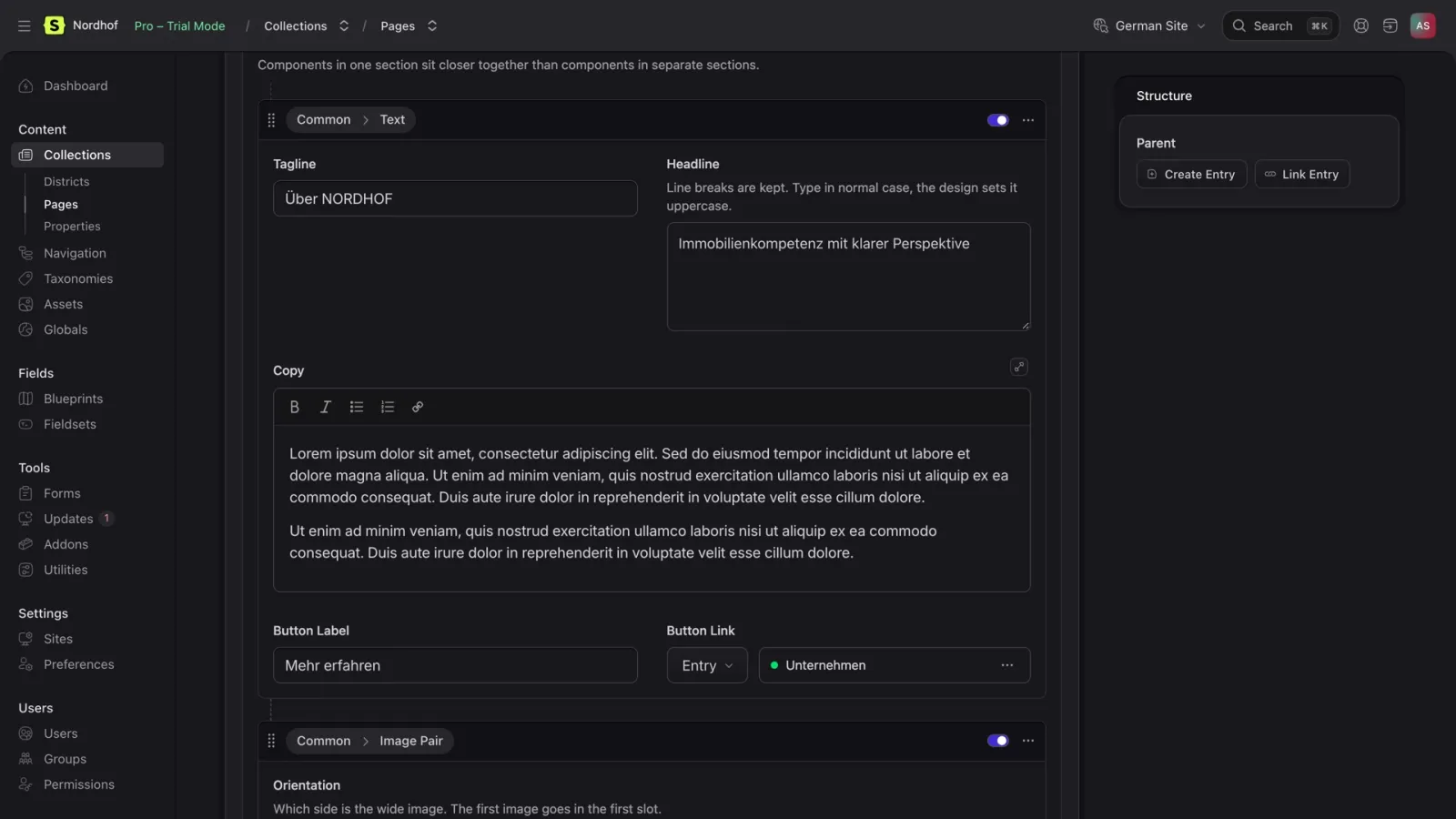
- The agency edits daily and has no developer. Anything that has to be changed after launch must be changeable by someone who has never seen the code, without breaking the page it sits on.
- Bilingual from the start
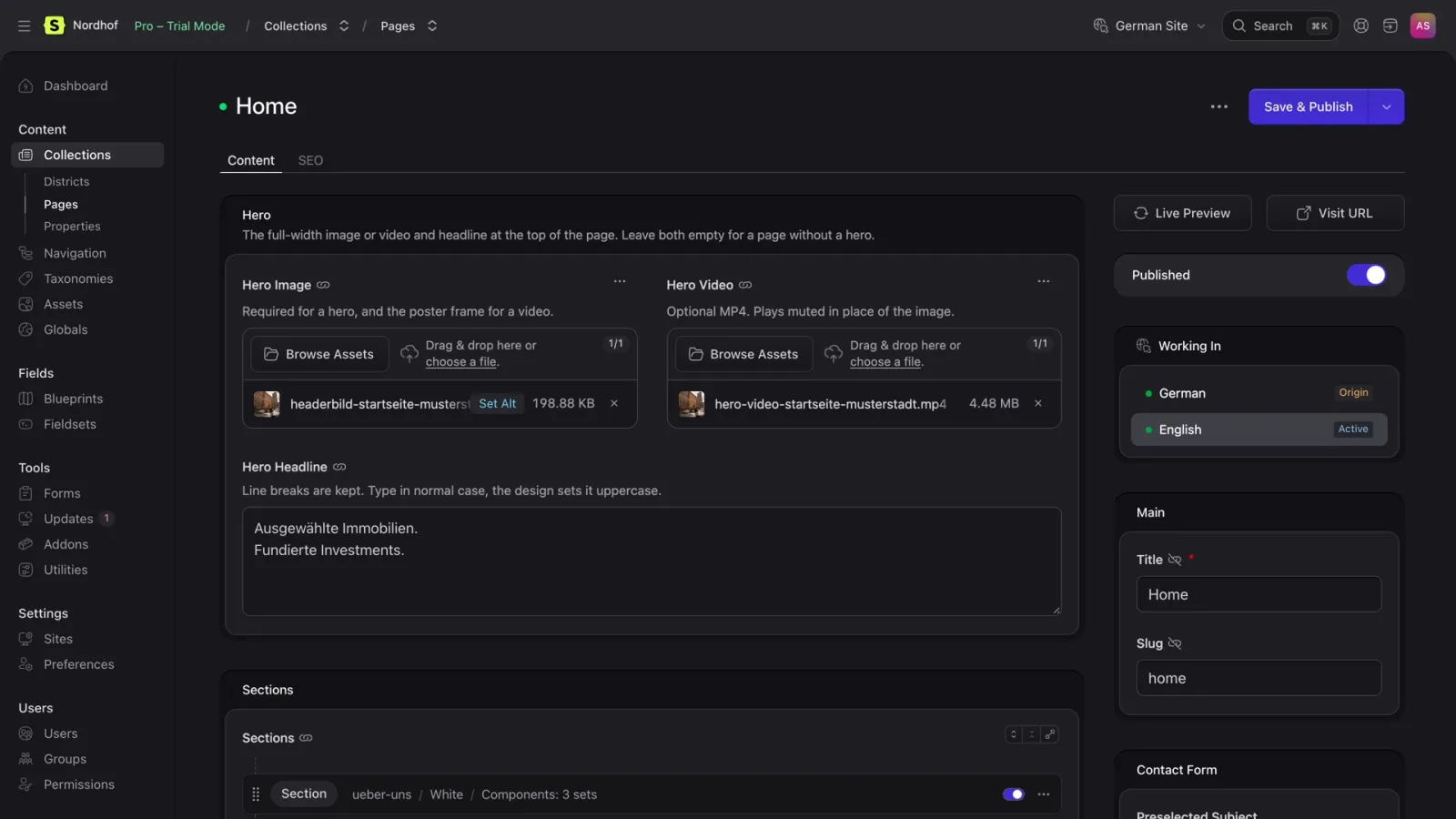
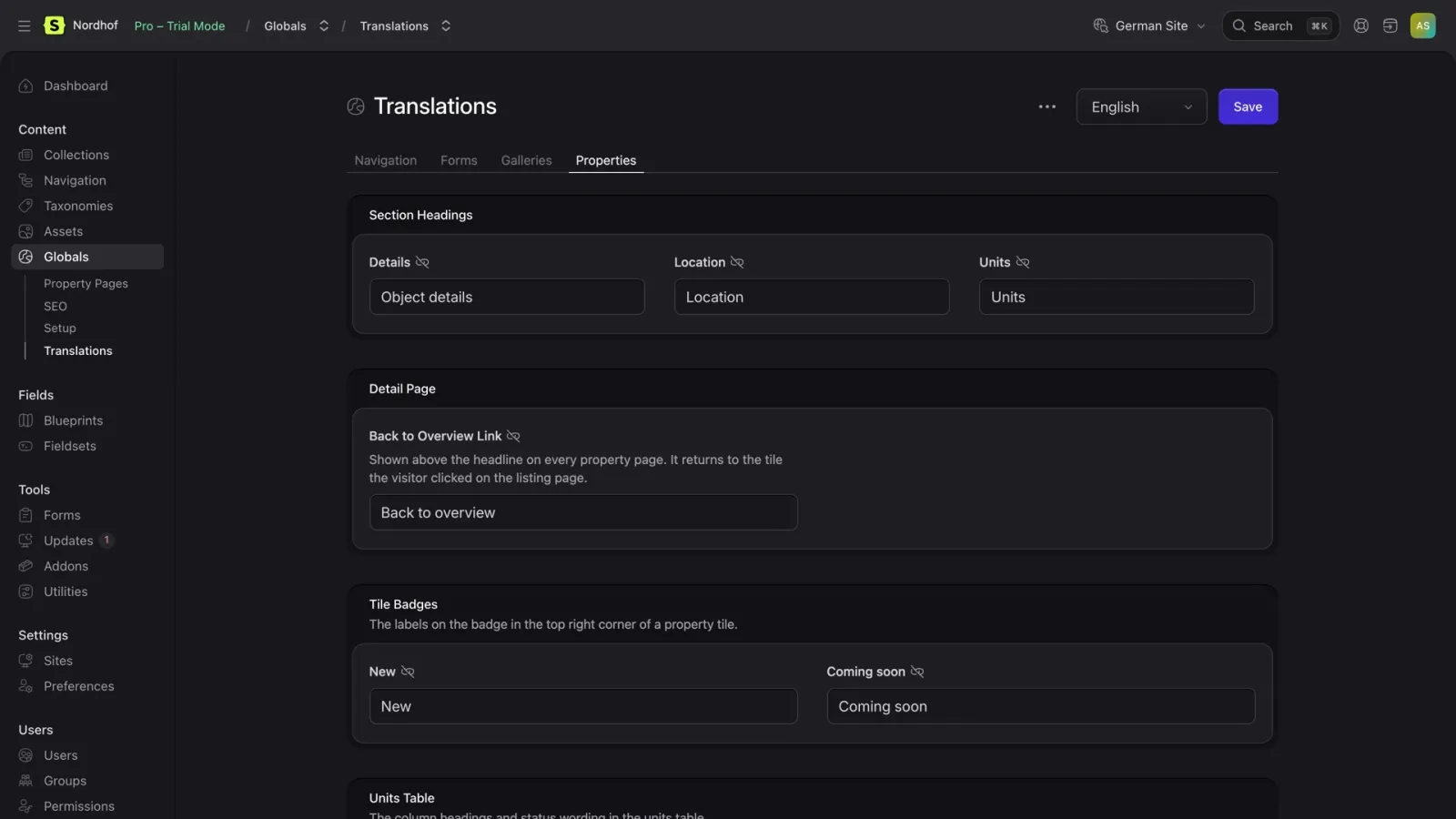
- Nearly every site ships German and English on day one, so the second language cannot be bolted on after launch. Every label has to be translatable from day one, which decides how the content is modeled rather than how it is translated.
- Anyone can take over
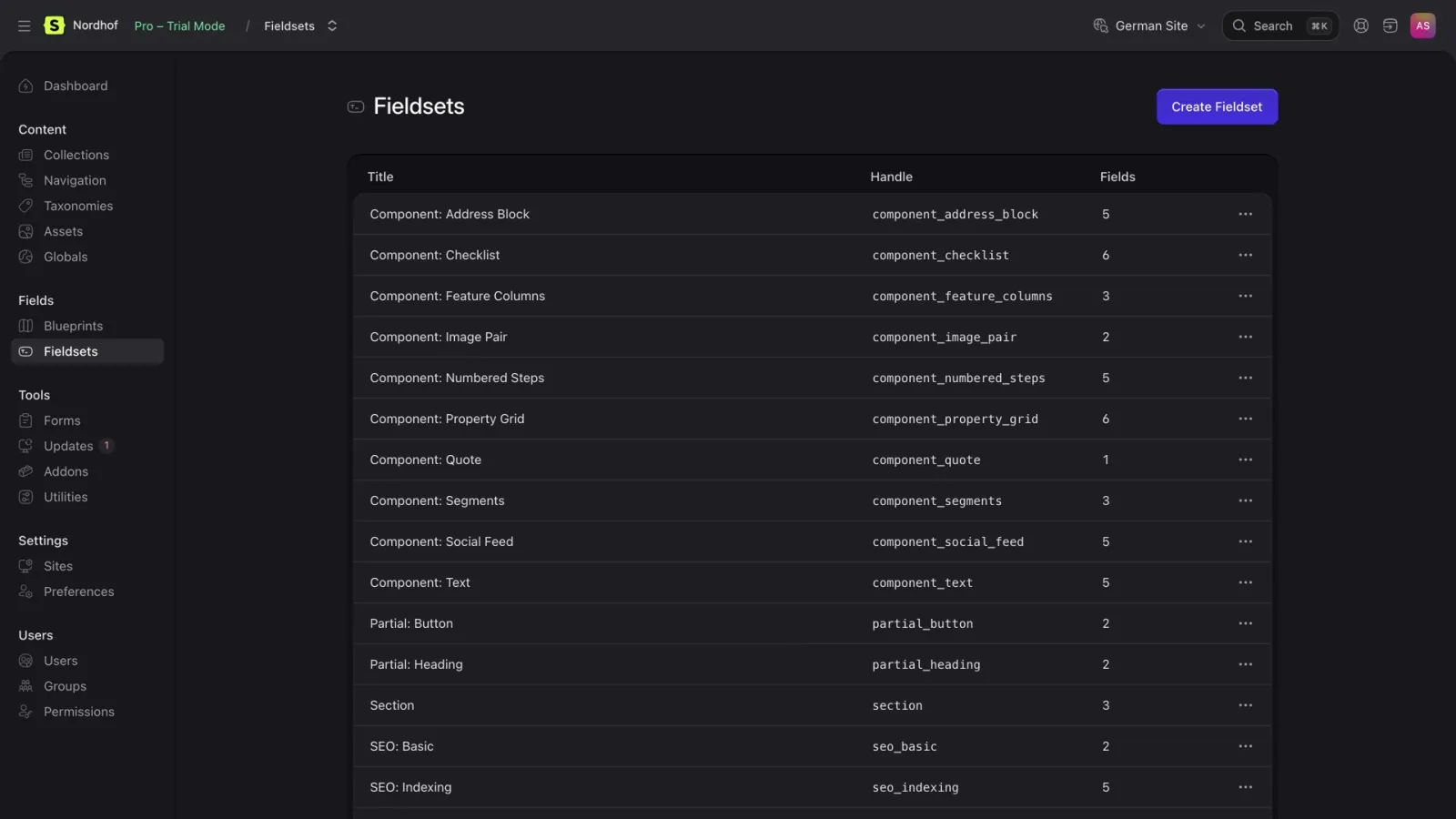
- White-label work is only worth buying if it does not create a dependency. Conventions are written down, the structure is the same across projects, and nothing clever is hiding where the next developer would not look.
03 / What I built
-
B/01
One foundation, eleven sites
Every site starts from the same foundation: sitemap, SEO fields, structured data, user roles, forms, image handling. None of it is visible, so it never limits the design. The parts that are identical on every project are already built and already proven, and the budget goes into what the client actually sees.
-
B/02
Sections and components
A page is a stack of sections, and every section holds components. An editor picks a component, fills it in and moves on. Background, spacing and width are a handful of choices rather than a page of settings, so a new page comes out looking like the design without anyone touching CSS.
-
B/03
Every word is editable
Button labels, form messages, table headings, error text, and the wording a screen reader reads out. All of it sits in the control panel in both languages. Nobody waits on a developer to fix a typo, and the second language is never half a page of English.
-
B/04
Accessibility from the first commit
Keyboard navigation, focus states, labels, contrast and heading order are part of building the page rather than a retrofit after somebody complains. It costs nothing to do it this way and a great deal to add it later, and it is the difference between passing an audit and asking the client for a second budget.
-
B/05
SEO that is already done
Titles, descriptions, canonicals, Open Graph, sitemap and robots ship with the build and stay editable per page. Your client does not need to hire an SEO agency to fix the basics, because the basics were done right from the start.
-
B/06
Structured data on every page
Schema.org markup for the organization, the breadcrumbs and the page type is generated from the content itself, so a search engine reads what a page is instead of guessing. That is what gets a result shown properly rather than as a bare blue link.
-
B/07
Speed is a build decision
Every image is generated at the size it is actually served, never larger than the original. Pages are rendered on the server and served from a cache, so they arrive as finished HTML instead of assembling themselves in the browser. Speed comes out of how the site is built, not from a plugin added at the end.
-
B/08
Nothing to break on an update
The sites I build from scratch run on no third-party add-ons at all. Nothing to license, nothing abandoned by its author two years later, nothing standing between the site and a Statamic update. Updating is a command, not a project.
-
B/09
Someone else's code, taken over
Three of the eleven were built by someone else and handed over without documentation, already live and already in use. Taking one over means reading all of it, fixing what is dangerous, and leaving it somewhere the agency is not stuck with me either.
04 / What changed
For the first year every new project was a copy of the last one. That is quick, and it works right up until one fix has to be made in six places at once.
Now a project starts from a clean install and the shared parts are added on purpose. The borrowed starter kit went first, then the hundred-field page blueprints, then the add-ons. Every site has been simpler to maintain than the one before it.
05 / Credits
Concept and design by the agency on every project, which prefers to remain anonymous. Development and maintenance by me. The screenshots come from a dummy website built with my standard process.
06 / Next step
Design finished, but nobody to build it?
Send me the design and the date it has to be live, plus how your team expects to edit it afterwards. You get a fixed price, a delivery date, and a client who never finds out I exist.